Unit 3 · Term 3 · 10 lessons
Naturalism
You perform a naturalistic duologue or monologue using Stanislavski’s techniques. You annotate a script for objectives, units, action verbs and subtext, then get it on its feet. This is the unit where the smallest choices matter most.
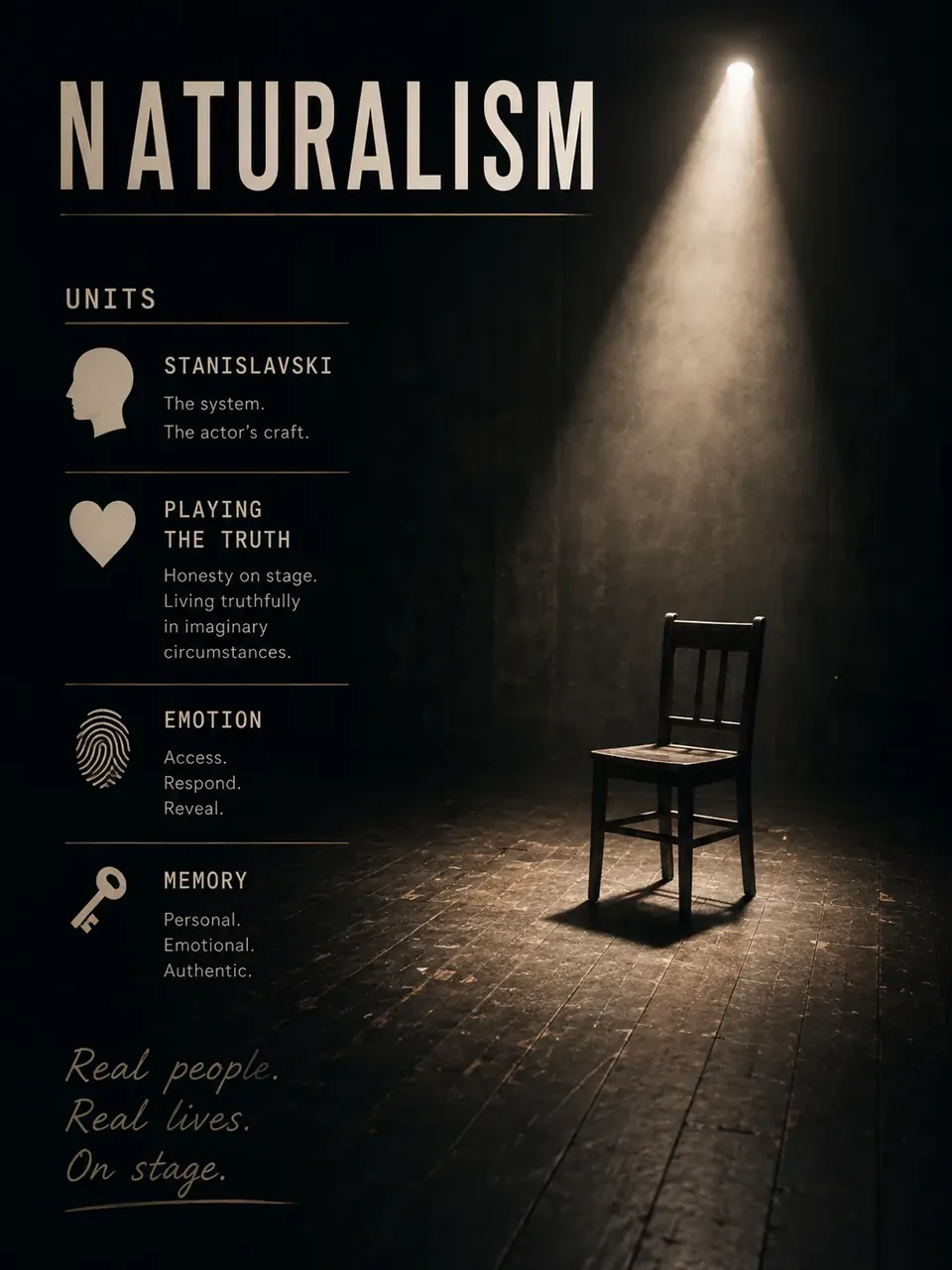
The unit
Stanislavski · naturalistic duologues and monologues
Communication combines verbal and non-verbal elements to express emotions and develop relationships in theatre.
What you hand in
Four things come out of this unit. Everything else is rehearsal.
A naturalistic duologue in pairs or a monologue solo.
Unit divisions, objectives, super objective and action verbs in the margins, with subtext in a second colour.
Plus your written artistic intention.
Including the blocking you tried and abandoned.
What goes in your journal
Your journal opens three times this unit. Your teacher will tell you when. Each moment wants two things. Evidence you gathered at the time, then writing that explains it. Nobody is marking your spelling or how neat it looks. They are marking your thinking.
Capture it while it is still messy. A blurry rehearsal photo of something you were still figuring out is worth more than a tidy one taken afterwards and the versions you rejected are what prove extensive exploration.
Research and given circumstances
- Your Naturalism in 60 Seconds recording and your Stanislavski fact file.
- Your completed six questions and the script title and character you are playing.
- Get creative: a photograph of your hot seating notes or the clip of naturalistic acting you analysed.
ResearchWho was Stanislavski and what was he reacting against? Explain one element of his system in your own words and cite where you found it.
JustifyWhy did you choose this script and this character? What about their situation made you think: I want to explore what this would feel like?
Annotated script and artistic intention
- Your annotated script: unit divisions, objectives, super objective and action verbs in the margins.
- Your subtext annotations in a second colour, your ground plan and your written artistic intention.
- Get creative: photograph the blocking you tried and abandoned. Rejected versions are what evidence extensive exploration.
CaptureWhich action verbs did you choose and what changed in the room when you played them?
DevelopWhere is the gap between what your character says and what they mean? How are you showing that gap without stating it?
Performance and reflection
- Your performance recording link, plus one photograph of the moment you are proudest of.
- Get creative: a still from the recording with your own annotation on it.
ReflectDid the performance achieve your artistic intention? Which of Stanislavski’s techniques made the most difference?
EvaluateWhere did the truth of it hold and where did you catch yourself performing rather than listening?
What a 5 and a 7 actually look like
Both of these answer the same journal question: Which action verbs did you choose and what changed in the room when you played them?
I chose the action verbs to persuade and to comfort for my lines. Playing them made my performance more natural and helped me get into character. It made the scene feel more realistic and believable for the audience.
I had been playing the whole scene to comfort, which is why it kept going soft and nothing really happened. My partner said it felt like we agreed with each other. So I changed the second unit to to provoke and kept the same lines. It changed how I used the space between us. I started moving closer to my partner, used more emphasis on certain words and made the pauses shorter because I was pushing for an answer. The words stayed exactly the same, but changing what I wanted from them changed the way I said them and how I used my body. The audience could see the pressure building and the relationship between the two characters changing without either of us raising our voices.
What’s the difference?
The first answer tells us what the student chose and that it helped. The second answer shows us what they actually changed and why.
- What I chose
- How I played it
- What I changed
- Why I changed it
- What happened to the audience
Think about what the audience could actually see or hear. Did you change your pace, volume, pauses, movement, eye contact, distance, posture or physicality?
Don’t just say “it created tension.” Explain what you did that created the tension.