Unit 2 · Term 2 · 13 lessons
Devised
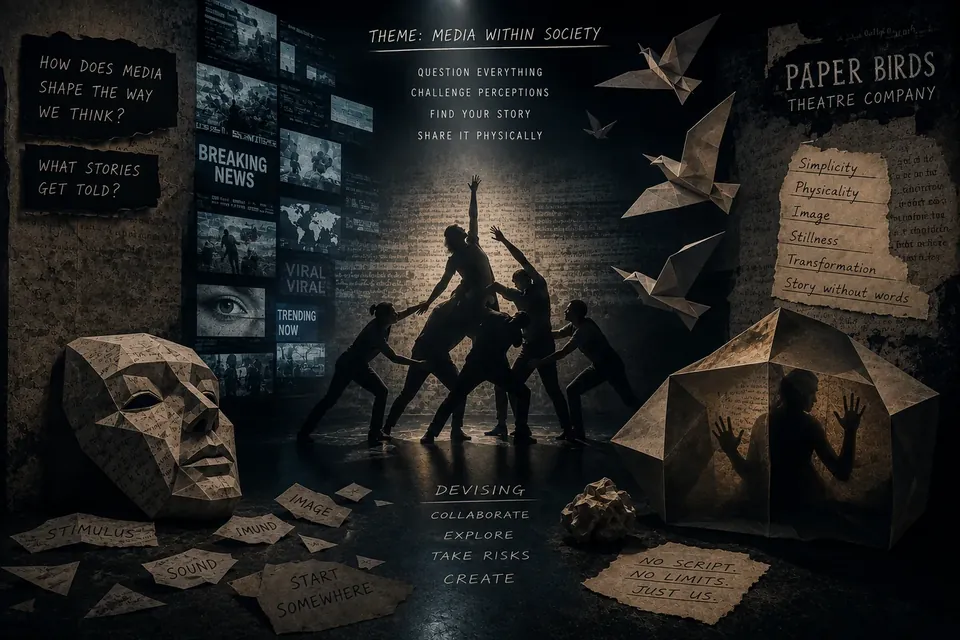
You build a piece from nothing. No script. You research a real issue in the media, find your own angle on it and devise from testimony, using the style of verbatim theatre and the creating techniques of the Paper Birds theatre company.
The unit
Verbatim theatre · The Paper Birds · media within society
The arts have the power to reshape our world and the way we perceive it, opening our minds to new possibilities and perspectives.
What you hand in
Four things come out of this unit. Everything else is rehearsal.
Your own piece, made from real testimony rather than a published script.
Images, headlines, a clip, real testimony and one statistic.
Plus at least one photograph of a version you rejected.
This is the only unit where Criterion D is formally assessed.
What goes in your journal
Your journal opens three times this unit. Your teacher will tell you when. Each moment wants two things. Evidence you gathered at the time, then writing that explains it. Nobody is marking your spelling or how neat it looks. They are marking your thinking.
Capture it while it is still messy. A blurry rehearsal photo of something you were still figuring out is worth more than a tidy one taken afterwards and the versions you rejected are what prove extensive exploration.
Research and your angle
- Group research document: images, headlines, a clip, real testimony and one statistic.
- Paper Birds research: one production and one thing that surprised you.
- A photo of your Recreate the Image still.
- Get creative: a screenshot of the headline that annoyed you, a voice note of someone you interviewed, a sketch of a moment you could not photograph.
ResearchSummarise your research into The Paper Birds. Which of their seven techniques did your group find most useful and why that one rather than the others?
ExploreWhich angle on media within society has your group chosen? What is the one thing you want an audience to notice about it?
Devising with the Paper Birds techniques
- Photo or clip of one Paper Birds technique in progress.
- Your written artistic intention and one photo of a version you rejected.
- Get creative: your alphabet script on paper, a ground plan sketch, a photo of the staging you tried first and abandoned. The rejected versions are what evidence extensive exploration.
CaptureChoose one moment from devising. What did you try, what did you throw away and why?
DevelopYou are using real words that belong to a real person. What responsibility does that carry and how are you handling it? How does this moment communicate your angle to an audience?
Performance and reflection
- Your performance recording link, plus one photo of the moment you are proudest of.
- Get creative: a still from the recording with your own annotation on it or a screenshot of an audience reaction.
ReflectReturn to Brecht. Was your piece a mirror or a hammer? Point to the exact moment where it worked or where it did not. What would you change with two more lessons?
EvaluateWhat did you contribute to the ensemble? Which technique changed your performance most and what exactly did it change? How have you developed as an artist this unit?
What a 5 and a 7 actually look like
Both of these write about the same technique: repetition.
“We used repetition in our performance to show how people see the same news stories again and again.”
We used repetition by repeating the same news headline several times during the performance. Each time it appeared, we changed one small detail, so the audience gradually heard a slightly different version of the same story. We chose this because we wanted to show how information can be changed or manipulated as it is repeated.
We also increased the tempo each time the headline was repeated. This made the information feel more urgent and meant the audience had less time to question what they were hearing. We wanted the audience to start questioning whether they were accepting the information because it was true or simply because they had heard it so many times.
This helped us explore the Statement of Inquiry because we were using the performance to change the way the audience perceived the information and encouraging them to consider a different perspective on how media can shape what we believe.
The difference is the thinking behind the choice. Show what you used, how you used it, why you used it, what it did to the audience and how it helped you explore the Statement of Inquiry.